
Veterinary Auto-Immune Disease Diagnostics Market
Number of pages: 100 | Report Format: PDF | Published date: May 24, 2023
Historical Years – 2021 | Base Year – 2022 | Forecasted Years – 2023-2031
|
Report Attribute |
Details |
|
CAGR |
7.4% |
|
Base Year for Estimation |
2022 |
|
Forecast Period |
2023 to 2031 |
|
Historical Year |
2021 |
|
Segments Covered |
Test Type, Indication, Animal Type, End User, and Region |
|
Regional Scope |
North America, Europe, Asia Pacific, Latin America, and the Middle East & Africa |
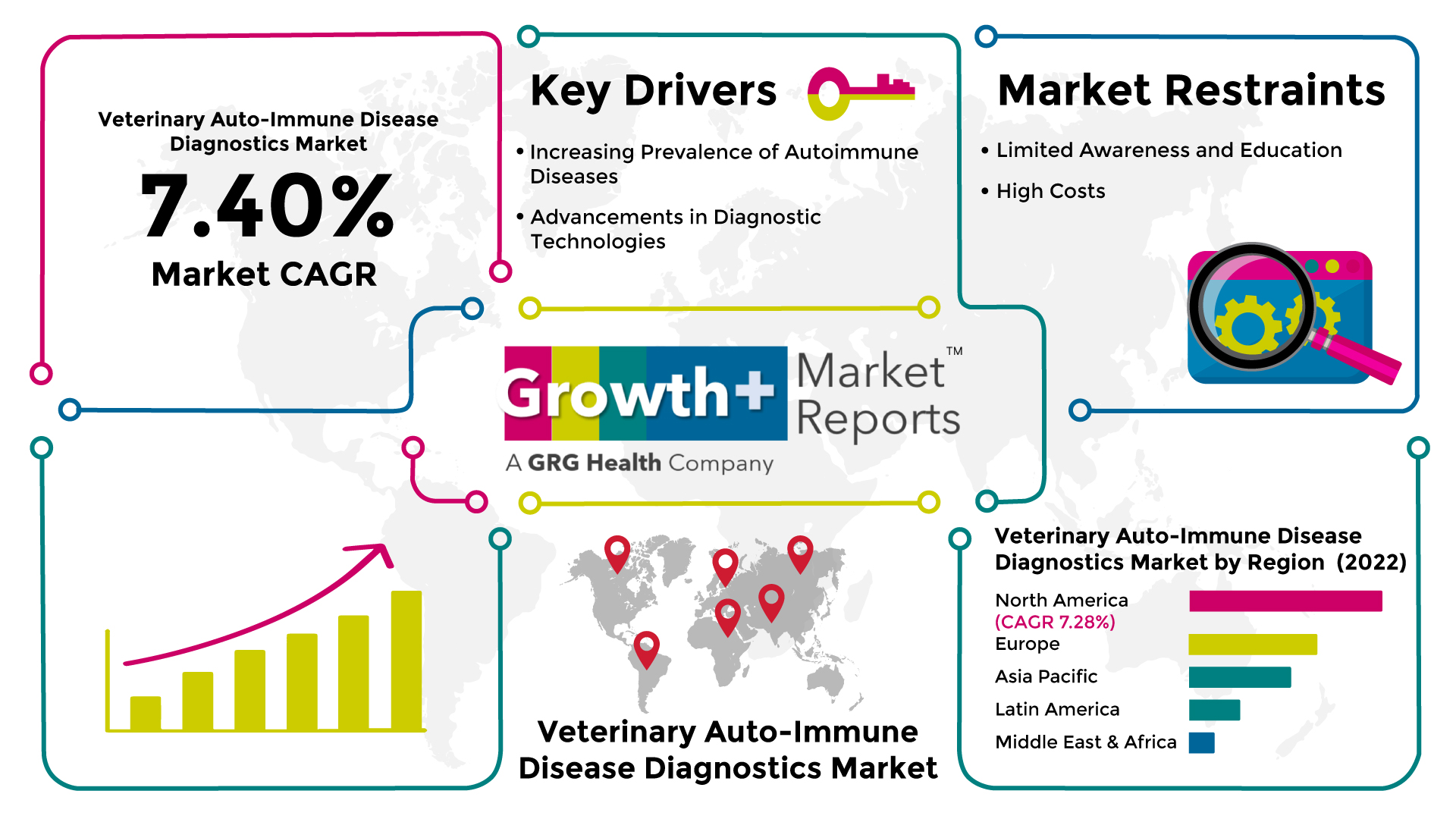
According to the deep-dive market assessment study by Growth Plus Reports, the global veterinary auto-immune disease diagnostics market is expected to register a revenue CAGR of 7.4% from 2023 to 2031.
Veterinary Auto-Immune Disease Diagnostics Market Fundamentals
Veterinary autoimmune disease diagnostics refer to the diagnostic procedures and tests used to identify and diagnose autoimmune diseases in animals. Autoimmune diseases occur when the immune system mistakenly targets and attacks the body's own tissues, leading to inflammation and damage. These conditions can affect various animal organs and systems, including the skin, joints, kidneys, liver, and blood. Veterinary autoimmune disease diagnostics involves a comprehensive approach that combines clinical examination, laboratory tests, imaging techniques, and specialized assays. The diagnostic approach for veterinary autoimmune diseases may vary depending on the suspected disease and the animal species involved. Diagnostic methods such as serological tests, blood tests, urine analysis, imaging techniques, and many others are used.
The global veterinary auto-immune disease diagnostics industry analysis report comprehensively analyzes the market, with the factors that either aid or impede the market growth, such as its drivers, restraints, and opportunities. The research provides insight into the companies that operate in the veterinary auto-immune disease diagnostics market and their efforts to position themselves as key players through expansion strategies and innovations. It also highlights recent developments that contribute to the veterinary auto-immune disease diagnostics market growth. The research also analyzes the impact of the COVID-19 pandemic.
This research is valuable for businesses seeking insights into the market, customers, and competition. The research provides special insights into the segmentation, regions, market size & projection, revenue CAGRs, and other important information that may help clients make the right decisions. The report assembles data from market players and professionals across the industrial value chain. The study also incorporates qualitative and quantitative assessments from industry professionals. Secondary research, surveys and interviews, and statistical modeling are all used in our research to estimate market size and projection. Our reports deliver the most reliable market data because of our specialized research methods.
Veterinary Auto-Immune Disease Diagnostics Market Dynamics
The rising prevalence of animal disease is the primary driver for global veterinary auto-immune disease diagnostics growth. Genetic predisposition, environmental triggers, and changes in pet lifestyles have led to an increased incidence of autoimmune disorders. This growing prevalence drives the demand for accurate and timely diagnostic tools to identify and manage these conditions. For instance, according to the World Organization for Animal Health’s information, one out of five animals are lost due to diseases every year. Moreover, significant advancements in diagnostic technologies have improved animal detection and diagnosis of autoimmune diseases. Newer laboratory techniques, imaging modalities, and serological assays enhance sensitivity, specificity, and efficiency in identifying autoimmune markers and associated abnormalities. Collaborations between diagnostic companies, research institutions, and veterinary clinics are driving innovation and the development of new diagnostic tools. These partnerships leverage expertise, resources, and funding to accelerate the advancement of veterinary autoimmune disease diagnostics.
Additionally, limited awareness and education, high costs, and limited availability of specialized tests are some restraints impeding the overall veterinary auto-immune disease diagnostics market growth.
Veterinary Auto-Immune Disease Diagnostics Market Ecosystem
Veterinary Auto-Immune Disease Diagnostics Market, by Test Type
Veterinary Auto-Immune Disease Diagnostics Market, by Indication
Veterinary Auto-Immune Disease Diagnostics Market, by End User
Veterinary Auto-Immune Disease Diagnostics Market by Indication
The urinalysis segment accounted for a significant revenue share of the market. It is a diagnostic test that analyzes the components and properties of urine to assess an individual's overall health, including the presence of autoimmune diseases. Urinalysis is a non-invasive and relatively simple diagnostic tool for detecting and monitoring various autoimmune diseases. Autoimmune diseases are characterized by the body's immune system mistakenly attacking its own healthy tissues and organs. Urinalysis helps identify markers, such as abnormal levels of specific cells, proteins, or metabolites in the urine, that may indicate the presence of autoimmune conditions.
Likely, autoimmune diseases can affect many cattle leading to various health issues. These diseases can impact different systems in cattle, including the skin, joints, digestive system, and reproductive system. Autoimmune conditions such as bovine pemphigus, systemic lupus erythematosus, and autoimmune hemolytic anemia are among the disorders that can occur in cattle. Ongoing research and development efforts focus on improving diagnostic techniques and developing novel diagnostic tools for cattle autoimmune diseases. These efforts enhance diagnostic tests' sensitivity, specificity, and efficiency, leading to more accurate and reliable results.
The market segmentation sections provide the veterinary auto-immune disease diagnostics market outlook in terms of the demarcation of different consumer groups. Market segmentation is the split of an industry into subgroups depending on characteristics such as test type, indication, animal type, and end user. Market segmentation data helps organizations understand the preferences and distinctive demands of different customer groups and implement targeted marketing strategies. This data also helps identify potential veterinary auto-immune disease diagnostics market demand opportunities.
Veterinary Auto-Immune Disease Diagnostics Market by Region
North America dominated the global veterinary auto-immune disease diagnostics market with the largest revenue share in 2022, with a CAGR of 7.28% during the forecast period, owing to a well-developed veterinary healthcare system with many veterinary clinics, hospitals, and specialized centers. Additionally, the region's advanced veterinary healthcare infrastructure, high pet ownership rates, and increasing awareness of autoimmune diseases contribute to market growth. For instance, according to the U.S. Census Bureau’s statistics 2021, in 2021, over 63.8 million of the 128.5 million settled housing units will have at least one pet. North America is at the forefront of technological advancements in veterinary diagnostics. The region has a strong presence of diagnostic companies, research institutions, and academic centers that drive innovation and develop cutting-edge diagnostic tools and technologies.
Based on the regions, the global veterinary auto-immune disease diagnostics market is segmented into:
The industry's regional segmentation provides insights into geographic pockets in terms of veterinary auto-immune disease diagnostics industry trends, market size, share, and growth rate. This information helps organizations assess potential growth opportunities in new regional markets, understand competitive threats, and develop localized sales and expansion strategies. This section also offers deeper insights into the regional and country-level veterinary auto-immune disease diagnostics market overview.
Key Components of the Report
Veterinary Auto-Immune Disease Diagnostics Market Competitive Landscape
The market competitive landscape analysis is performed by gathering and evaluating data about the key competitors, industry trends, and market dynamics. It involves collecting and analyzing data on factors such as products, pricing, geographic reach, customer demographics, marketing tactics, and recent developments. Competitive landscape analysis can help organizations identify present or prospective opportunities and risks in the market.
Veterinary Auto-Immune Disease Diagnostics Market Strategic Developments
Reasons To Buy This Report
Key Strengths of Our Report
Target Audience to Benefit from this Report.
Veterinary autoimmune disease diagnostics refer to the diagnostic procedures and tests used to identify and diagnose autoimmune diseases in animals.
Mergers, acquisitions, and partnerships are the major strategies adopted by key market players.
North American region will have the largest veterinary auto-immune disease diagnostics market size during the forecast period from 2023 to 2031.
The revenue CAGR of the veterinary auto-immune disease diagnostics market during the forecast period will be 7.4% from 2023 to 2031.
Growing awareness and veterinary expertise is the most prominent veterinary auto-immune disease diagnostics industry trend.
The limited awareness and education, high costs, and limited availability of specialized tests are some key challenges hampering the growth of the global veterinary auto-immune disease diagnostics market.
The increasing prevalence of autoimmune diseases and advancements in diagnostic technologies are growth opportunities in the global veterinary auto-immune disease diagnostics market.
Some of the key players in the veterinary auto-immune disease diagnostics market are Zoetis Services LLC, Accuplex Diagnostics, Neogen Corporation, Shenzhen Mindray Animal Medical Technology Co., LTD., and Abaxis, Inc.
The urinalysis segment accounted for a significant revenue share of the veterinary auto-immune disease diagnostics market.
*Insights on financial performance are subject to the availability of information in the public domain